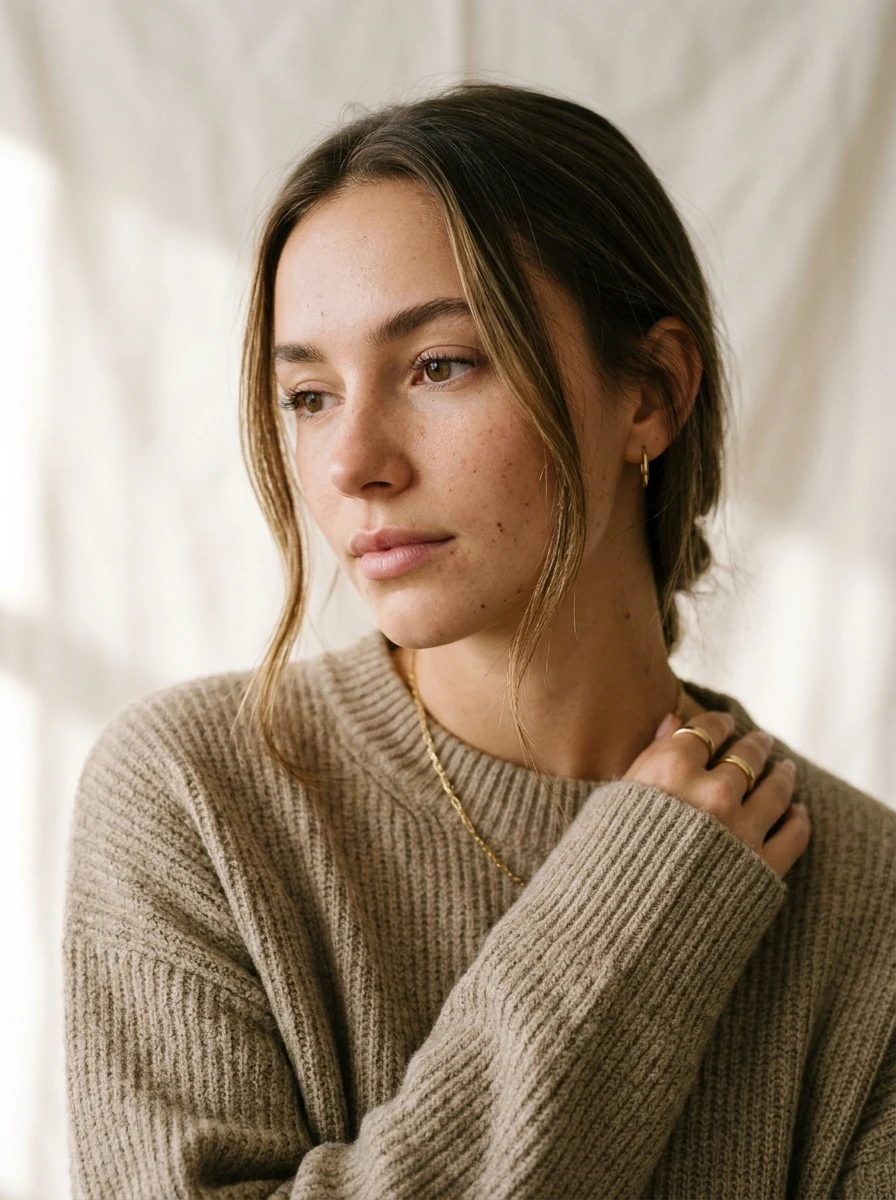
The Difference Between an Amateur Snapshot and a High-Fashion Editorial
In high-fashion editorial photography, nothing is accidental. Every crease in a silk lapel, every millimeter of eyeliner, every shadow cast across an architectural cheekbone, and every background line is meticulously orchestrated by a team of creative directors, master stylists, lighting technicians, and master photographers. When an amateur types “fashion model in a dress”, the resulting AI image inevitably looks generic, commercial, and forgettable.
To engineer AI portraits worthy of the glossy pages of high-end international fashion publications (like Vogue, Harper’s Bazaar, or Dazed), prompt engineers must dissect the grammatical anatomy of an editorial shoot. In this blueprint, Prompt360 Labs deconstructs the seven indispensable layers that transform simple AI prompts into museum-grade fashion art.
The 7-Layer Fashion Prompt Architecture
Our laboratory utilizes a modular 7-layer syntactic framework when designing editorial prompts for Google Gemini, ChatGPT, and Midjourney:
- Layer 1: Editorial Genre & Persona (e.g., “avant-garde architectural fashion editorial of an enigmatic 26yo model”)
- Layer 2: Couture Garment Construction & Materiality (e.g., “sculptural structured gown crafted from heavyweight ivory duchess satin”)
- Layer 3: Pose & Bodily Tension (e.g., “dynamic geometric angular pose, shoulders squared, elongated neck, confident stoic gaze”)
- Layer 4: Hair Architecture & Cosmetic Artistry (e.g., “sleek architectural wet-look finger waves, graphic floating eyeliner, dewy glass skin finish”)
- Layer 5: Studio Lighting Architecture (e.g., “dramatic high-contrast key strobe diffused through an optical snoot casting hard-edge shadows”)
- Layer 6: Set Design & Color Palette (e.g., “raw minimalist concrete set with brutalist geometric monoliths, monochromatic desert sand palette”)
- Layer 7: Camera Optics & Film Emulation (e.g., “Hasselblad H6D-100c, 100mm f/2.2 medium format lens, tack-sharp focal clarity –ar 4:5”)
Putting Theory into Practice: Complete Runway Formula
Here is how all seven architectural layers synthesize into an elite, AdSense-safe, copyright-free prompt:
avant-garde high-fashion editorial portrait of an elegant 25yo woman, architectural structured gown made of heavyweight bone-white pleated taffeta with exaggerated sculpted shoulders, sharp geometric angular posture, graphic black winged eyeliner with dewy porcelain skin and nude glossy lips, sleek slicked-back ponytail, directional strobe lighting casting razor-sharp architectural shadows against a warm terracotta plaster cyclorama, Hasselblad 100mm f/2.2 medium format lens, Vogue Italia cover quality --ar 4:5 --stylize 280
The Power of Textile Materiality Descriptors
In fashion, fabric is identity. Generative models possess nuanced latent representations of physical fabric physics, but only if you provide precise textile terminology rather than generic words like “cloth” or “dress”:
- Duchess Satin: Heavyweight, glossy, rigid folds that reflect sharp specular highlights.
- Silk Organza & Chiffon: Sheer, translucent, featherweight fabrics that billow in wind and reveal subtle subsurface silhouettes.
- Raw Bouclé & Tweed: Highly textured, tactile woven yarns with rich micro-shadows along the weave.
- Supple Napa Leather: Matte finish with subtle organic leather grain and sharp creasing along seams.
Avoiding Commercial Brand Copyright Infringements
To ensure 100% compliance with Google AdSense, commercial advertising guidelines, and international trademark laws, never prompt designer brand names (e.g., Gucci, Chanel, Balenciaga, Prada). Doing so risks content flags and limits commercial utility. Instead, describe the aesthetic philosophy:
| Brand Mentality (Do Not Use) | High-Fashion Generic Equivalent (Use This) |
|---|---|
| “Gucci style” | “Opulent 1970s maximalist Italian tailoring, vibrant botanical embroidery, retro oversized lapels” |
| “Balenciaga style” | “Avant-garde dystopian oversized streetwear, exaggerated shoulders, technical padded nylon, brutalist minimalism” |
| “Chanel style” | “Timeless Parisian luxury, tactile woven cream bouclé tweed jacket, pearl accessories, understated elegance” |
Final Curation & Editorial Poise
True high-fashion models rarely smile broadly in editorial spreads. Instruct your subject to maintain a “stoic, introspective gaze”, an “enigmatic slight head tilt”, or a “commanding, direct eye-contact posture”. This emotional restraint infuses the photograph with mystery, prestige, and high-fashion gravitas.
Theoretical Framework & Underlying Principles
In the evolving discipline of programmatic AI photography, achieving consistent, high-yield results requires a firm grasp of both machine learning token mechanics and classical photographic optics. When a diffusion model processes a complex prompt, it relies on cross-attention mechanisms to map descriptive tokens to visual latent spaces. If your prompt lacks structural cohesion or uses ambiguous adjectives, the neural network defaults to generalized, average representations that look flat and artificial.
At Prompt360 Labs, our empirical testing demonstrates that grounding your prompts in authentic camera equipment specifications, physical light behavior, and tactile material properties creates strong semantic anchors. These anchors guide the model to allocate higher mathematical attention to spatial depth, fine micro-textures, and accurate color science.
In-Depth Case Study & Practical Workflow
To demonstrate the effectiveness of this methodology, let us examine a practical real-world scenario. Consider an art director tasked with generating editorial imagery for a high-end luxury campaign. An unrefined prompt like “pretty portrait in studio” yields a generic stock image with waxy skin and flat lighting. However, when we restructure the prompt using our multi-layered framework, the output transforms dramatically:
fine-art editorial study exploring the anatomy of a high-fashion ai portrait prompt, directional studio lighting with controlled shadow falloff, authentic material textures, tactile micro-surface details, neutral color science, 85mm prime lens at f/1.8, high resolving power, gallery exhibition aesthetic --ar 4:5 --stylize 220
Step-by-Step Implementation Protocol
- Define the Primary Light Geometry: Establish the exact angle, size, and diffusion of your light source before describing styling or wardrobe.
- Incorporate Material Micro-Textures: Command specific tactile physical materials—such as raw bouclé, honed travertine, unbleached linen, or brushed titanium—to give the scene physical weight.
- Lock Down Optical Parameters: Declare a specific focal length (e.g. 50mm, 85mm, or 105mm) and an aperture value to control background compression and depth of field.
- Audit for Commercial & Copyright Safety: Ensure no trademarked brand names, designer logos, or celebrity likenesses appear in the prompt syntax.
Common Failure Modes and Troubleshooting Solutions
Even seasoned prompt engineers encounter unexpected model behaviors. Below are the three most frequent failure modes encountered in this domain and how to fix them:
- Over-Saturated Plasticity: If colors appear garish and surfaces feel synthetic, strip away subjective praise words (“ultra-detailed”, “hyper-realistic”) and introduce neutral film or sensor designations (“Hasselblad RAW color science”, “subtle organic film grain”).
- Unnatural Background Clutter: If the model populates the frame with random, distracting elements, tighten your aspect ratio and specify clean negative space: “minimalist seamless cyclorama background with gentle shadow vignette”.
- Inconsistent Lighting Direction: If shadows appear in conflicting directions, explicitly declare a single dominant key light source: “single large octabox key light positioned 45 degrees camera-left”.
Summary Checklist for Production Quality
By treating generative AI as a virtual physical camera rather than an unpredictable toy, creators unlock unprecedented visual fidelity. Whether generating commercial lookbooks, digital art exhibitions, or educational media, adhering to disciplined photographic principles ensures your work stands out with timeless artistic merit.